Digital Twins and Cooperative Mobility
Digital representations and connected systems for cooperative maneuvers, evaluated through co-simulation, prototypes, and selected controlled vehicle studies.
Contributions and publications →
Senior Principal Researcher
Toyota Motor North America R&D, InfoTech Labs
Ph.D., Electrical and Computer Engineering, The University of Texas at Austin
I develop AI and computing methods for connected vehicles: digital twins for cooperative maneuvers, models of individual driving behavior, and language-guided assistance. I lead collaborative research that connects these questions to working systems, evaluated through driving data, simulation, computing testbeds, and controlled vehicle studies. Earlier contributions address energy-efficient computing and signal processing.
Research
Connecting models of people and traffic with cooperative vehicles, generative AI, and resource-aware computing.
Digital representations and connected systems for cooperative maneuvers, evaluated through co-simulation, prototypes, and selected controlled vehicle studies.
Contributions and publications →Predicting surrounding traffic, learning individual driving preferences, and modeling driver intention and human trust for assistance that accounts for people.
Contributions and publications →Benchmarks, language interfaces, and generative models for understanding driving scenes, assisting drivers, and evaluating connected and autonomous systems.
Contributions and publications →Data sharing, information freshness, computation placement, and measured AI execution costs for connected systems under latency, bandwidth, and energy constraints.
Contributions and publications →Explore the earlier computing foundations in Energy- and Resource-Efficient Computing →
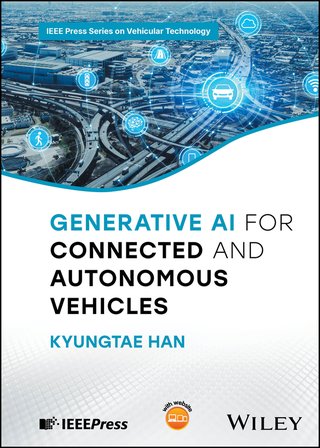
Featured Book
Kyungtae Han
Wiley-IEEE Press
Forthcoming · November 2026
Selected work
Collaborative work connects human, vehicle, and traffic digital twins to cloud–edge–device systems and cooperative merging.
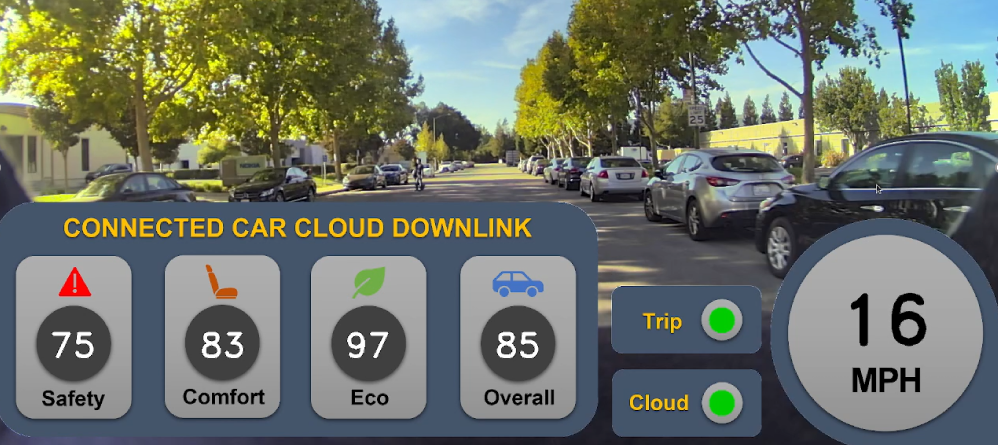
Mobility Digital Twin's cloud-based driver-scoring demonstration in Mountain View, California.
Z. Wang et al., Mobility Digital Twin: Concept, Architecture, Case Study, and Future Challenges, IEEE IoT Journal (2022), Figure 3. DOI: 10.1109/JIOT.2022.3156028. © 2022 IEEE. Extracted from author manuscript; labels unchanged. Reused for the coauthor's personal academic use; no IEEE endorsement. Source for mobility-driver-scoring-field IEEE author-retained rights (not an open license)
Merging advisories were tested with passenger vehicles in a controlled field study; game-theoretic coordination was evaluated in Unity–SUMO co-simulation.
Liao et al., IEEE T-ITS 2022Liao et al., IEEE T-SMC 2022Wang et al., IEEE IoT-J 2022
Research detailsCollaborative methods personalize car-following and predict trajectories from driving history and vehicle interactions.
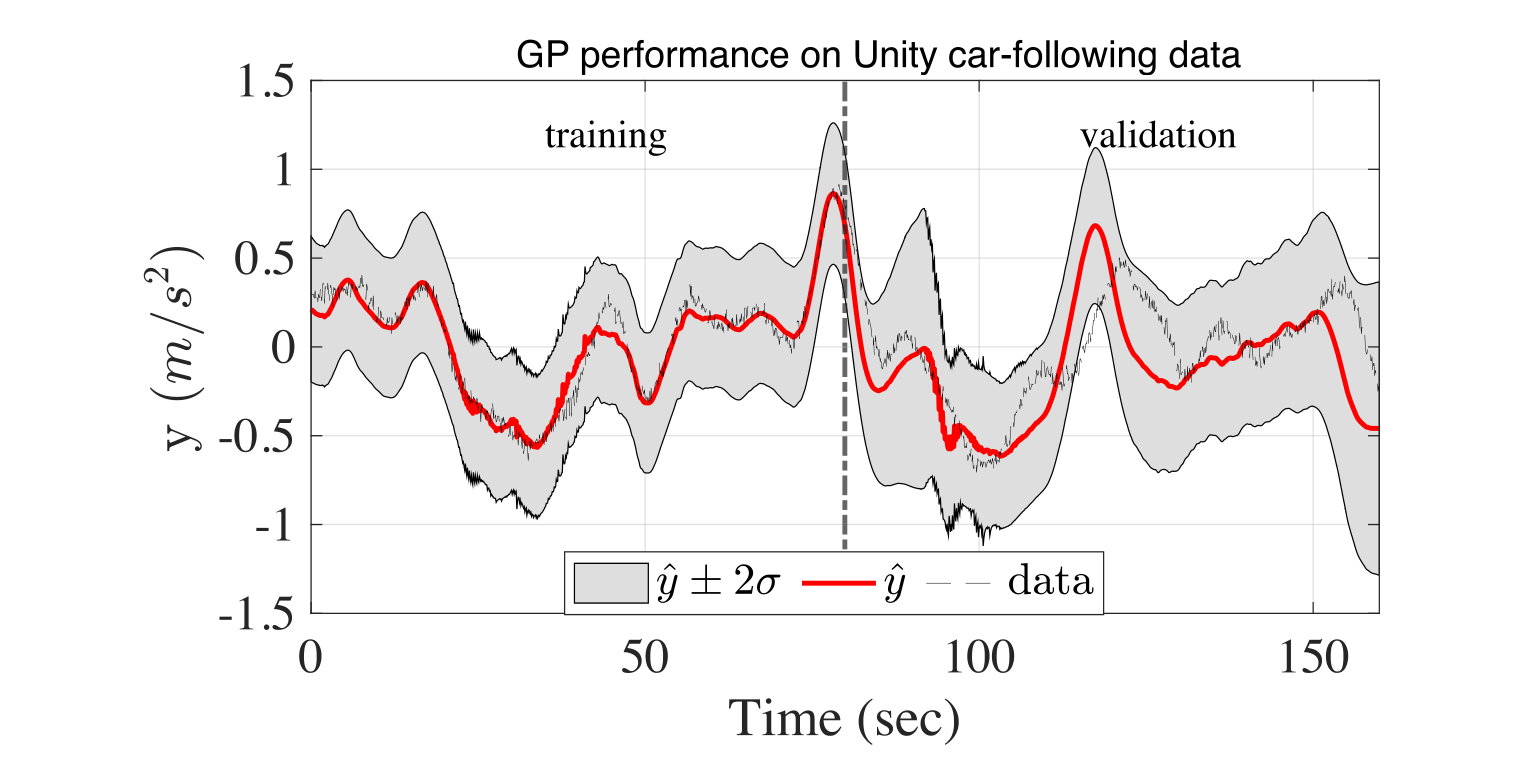
Driver-specific Gaussian-process acceleration predictions versus recorded simulator driving, with separate training and validation intervals.
Y. Wang et al., Gaussian Process-Based Personalized Adaptive Cruise Control, IEEE TITS (2022), Figure 5. DOI: 10.1109/TITS.2022.3174042. © 2022 IEEE. Rasterized and cropped; data and labels unchanged. Reused for the coauthor's personal academic use; no IEEE endorsement. Source for personalized-gp-acc-validation IEEE author-retained rights (not an open license)
Naturalistic data and human-in-the-loop studies evaluate ACC and prediction; driver-digital-twin lane-change prediction also has a connected-vehicle field implementation.
Wang et al., IEEE ITSC 2021Wang et al., IEEE T-ITS 2022Zhao et al., IEEE ICRA 2022Abdelraouf et al., IEEE ITSC 2023Liao et al., IEEE IoT-J 2023
Research detailsCoauthored work provides NuPlanQA for multi-view scene understanding and LaMPilot for language-generated programs over established driving functions.
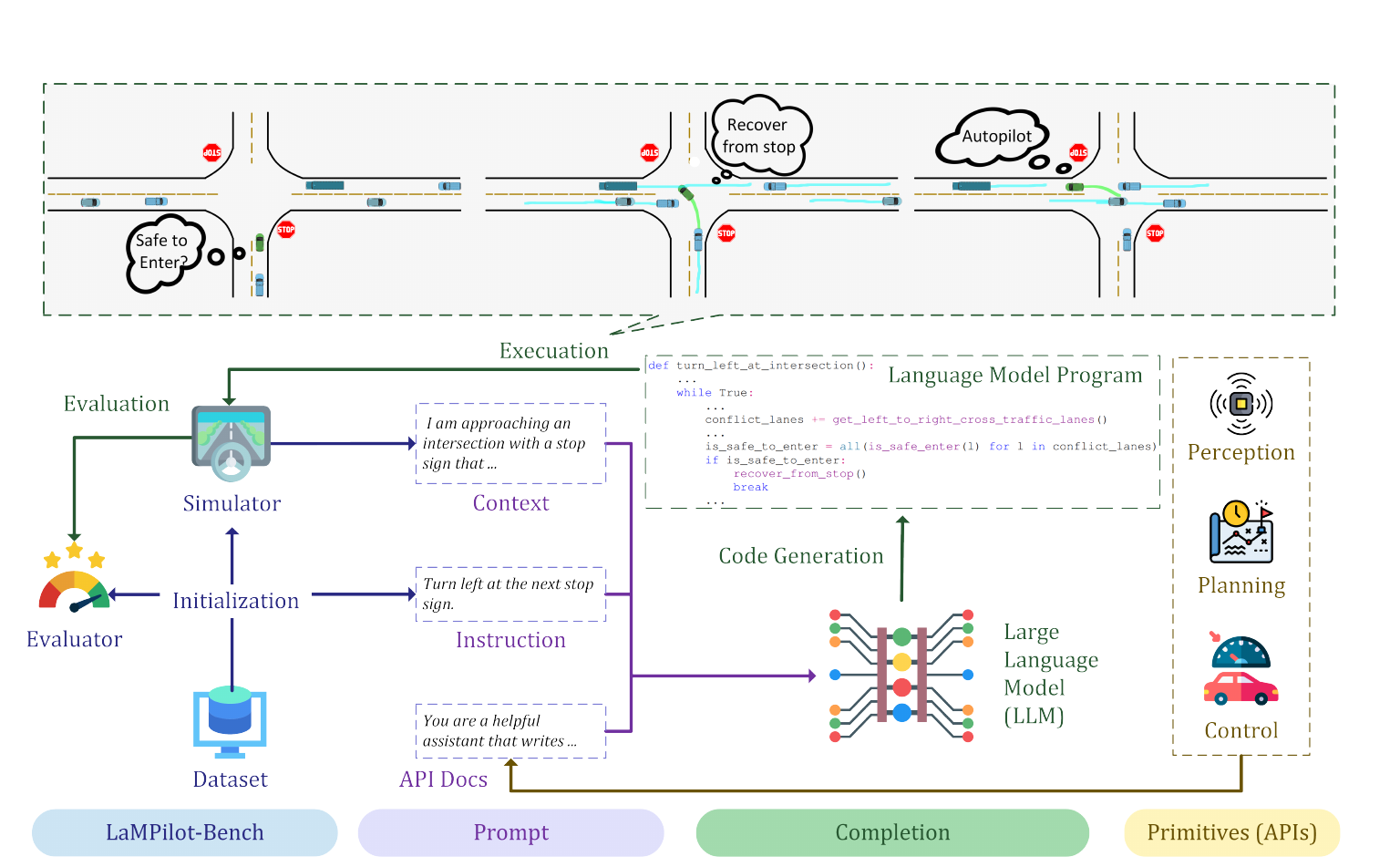
LaMPilot's published framework turns language instructions into executable driving programs for evaluation in simulation.
Yunsheng Ma and coauthors (2024), Figure 1, arXiv:2312.04372v2. CC BY-NC-SA 4.0. Rasterized and cropped from the author preprint; labels unchanged. Source for lampilot-framework CC BY-NC-SA 4.0
NuPlanQA benchmarks perception and spatial reasoning on driving imagery; LaMPilot evaluates instruction-following programs in simulation.
NuPlanQA, ICCV 2025LaMPilot, CVPR 2024
Research detailsCollaborative work developed AdaMap’s adaptive point-cloud sharing and lm-Meter’s on-device language-model profiling.
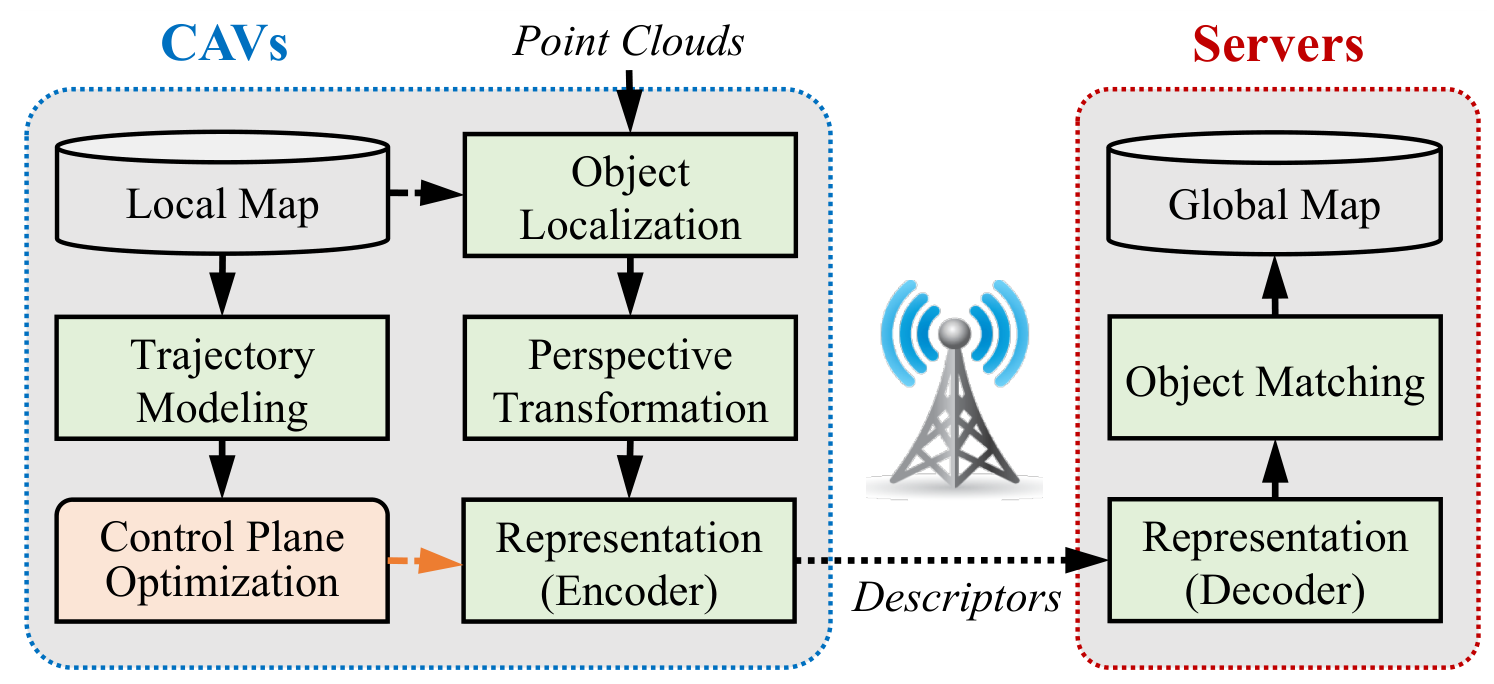
AdaMap’s published vehicle-to-edge architecture, evaluated through emulation with real computation and simulated networking.
Q. Liu et al., AdaMap: High-Scalable Real-Time Cooperative Perception at the Edge, SEC '23 (2023), Figure 3. © 2023 owner/author(s). Publication rights licensed to ACM. Rasterized/cropped from arXiv:2309.13526v2; labels unchanged. Personal use; not for redistribution. Version of Record: DOI 10.1145/3583740.3626612. Source for adamap-published-overview ACM author-reuse policy (not an open license)
AdaMap uses CARLA-trace emulation with simulated networking; lm-Meter measures latency on commercial mobile platforms. Related studies measure cross-device energy.
AdaMap, ACM/IEEE SEC 2023lm-Meter, ACM/IEEE SEC 2025Tu et al., ACM/IEEE SEC 2023
Research detailsEarlier contributions include sensitivity-guided fixed-point wordlength search, checksum-based image-change detection, and a hybrid display frame buffer.
Evaluations span wireless-demodulator designs, an FPGA image-change prototype, and display-content and energy models for the frame buffer.
Han and Evans, EURASIP JASP 2006Han et al., IEEE ICCD 2009Han et al., ISLPED 2013
Research detailsLeadership
Research program development and university collaboration at Toyota and Intel Labs.
At Toyota Motor North America R&D, InfoTech Labs, I led a multi-university research program and collaborations in digital twins, connected mobility, personalized assistance, and edge computing, connecting scientific methods with experimental systems and published research.
Previously at Intel Labs, I served as Technical Champion for a four-university research program in energy-efficient computing and system architecture, shaping research directions and coordinating technical reviews with academic investigators.
Publications
A curated selection from the publication record.
IEEE T-ITS 2022
X. Liao, Z. Wang, X. Zhao, K. Han, P. Tiwari, M. Barth, and G. Wu
Connects digital twins to cooperative ramp-merging advisories over vehicle-to-cloud communication, with a controlled passenger-vehicle field implementation.
IEEE T-ITS 2022
Y. Wang, Z. Wang, K. Han, P. Tiwari, and D. Work
Learns individual car-following preferences with Gaussian processes and combines them with a predictive safety filter, evaluated in numerical and human-in-the-loop simulator experiments.
ICCV 2025
S. Park, C. Cui, Y. Ma, A. Moradipari, R. Gupta, K. Han, and Z. Wang
NuPlanQA benchmarks multi-view driving-scene understanding on real-world imagery, evaluating multimodal models' perception and spatial reasoning.
CVPR 2024
Y. Ma, C. Cui, X. Cao, …, K. Han, …, and Z. Wang
LaMPilot translates language instructions into programs over established driving functions and benchmarks instruction following in simulated driving scenarios.
ACM/IEEE SEC 2023
Q. Liu, Y. Xue, Y. Zhang, D. Chen, and K. Han
AdaMap selects and compresses shared point clouds for cooperative perception under latency constraints, evaluated with vehicle/server computation and simulated networking on CARLA traces.
EURASIP JASP 2006
K. Han and B. Evans
Uses sensitivity to both hardware complexity and output error to search fixed-point wordlengths, evaluated on wireless-demodulator designs.
Teaching
Designing advanced research training in generative AI for vehicles and mentoring graduate researchers.
Designed and taught an advanced two-part curriculum at Toyota Motor North America's InfoTech Labs, combining technical foundations with hands-on applications to connected and autonomous vehicles.
Part I
2025
Language models, retrieval-augmented generation, function calling, fine-tuning, vision-language models, and agents for driving applications, with hands-on labs.
Part II
2026
Diffusion and flow-matching models, VAEs and GANs, video-language models, distillation for edge inference, closed-loop simulation, and evaluation, safety, and trust.
I mentor graduate research interns on collaborative studies, from formulating research questions to building prototypes and evaluating results.
Service
Publication record: 97 journal and conference papers (21 journal, 76 conference); 2 books and 1 book chapter; inventor on 60 publicly listed granted U.S. patents. Full list →
News
October 2026
Call for papers: 2nd International Workshop on AI-native Connected Mobility (ACM’27), held with IEEE CCNC 2027 in Las Vegas. Workshop page →
September 2026
Paper accepted in IEEE Transactions on Mobile Computing: “REAL: A Reinforcement Learning-based Intelligent Offloading Framework for Edge-Assisted MAR.”
August 2026
Paper accepted at EMNLP 2026 (Main Conference): “How Do Prompt Variations Affect Energy Consumption in On-Device LLMs?” View paper →
August 2026
Completed Part II of the internal course Generative AI for Connected and Autonomous Vehicles at Toyota InfoTech Labs, covering diffusion, VideoLLMs, edge distillation, simulation, and AI trust.
May 2026
Paper accepted at IEEE ITSC 2026: “Tonic Meta-Control for Adaptive Safety-Compute Allocation via Persistent Vigilance Dynamics.” Project page →
April 2026
Paper published in Proceedings of the IEEE: “LLM4AD: Large Language Models for Autonomous Driving.” View paper →
2026
Companion site for the IEEE-Wiley book Generative AI for Connected and Autonomous Vehicles is now available, with hands-on labs and instructor resources. Book webpage →
2025
Papers at IEEE ITSC 2025 (Scene-Aware Conversational ADAS), ICCV 2025 (NuPlanQA), IEEE/RSJ IROS 2025, and ACM/IEEE SEC 2025 (lm-Meter, PlatformX).
Contact
For research collaborations, workshops, or questions about this work.