Generative and Agentic AI for Connected and Autonomous Systems

Research question

What can multimodal and language models understand about a driving scene, and how can their outputs support useful interaction? Collaborative research develops driving-scene benchmarks, instruction-based interfaces over established driving functions, and scene-grounded dialogue. Complementary studies investigate scenario generation, traffic simulation, and selective reasoning, each with its own evaluation task.

Methods & contributions

  1. Making model capabilities testable

    NuPlanQA provides multi-view driving-scene question answering and evaluates perception and spatial reasoning. PDB-Eval tests descriptions and explanations of personalized behavior. Concept-bottleneck control studies explanations through human-understandable concepts.

    NuPlanQA, ICCV 2025 · PDB-Eval, IEEE IV 2025 · Echterhoff et al., WACV 2024

  2. Connecting instructions to existing driving functions

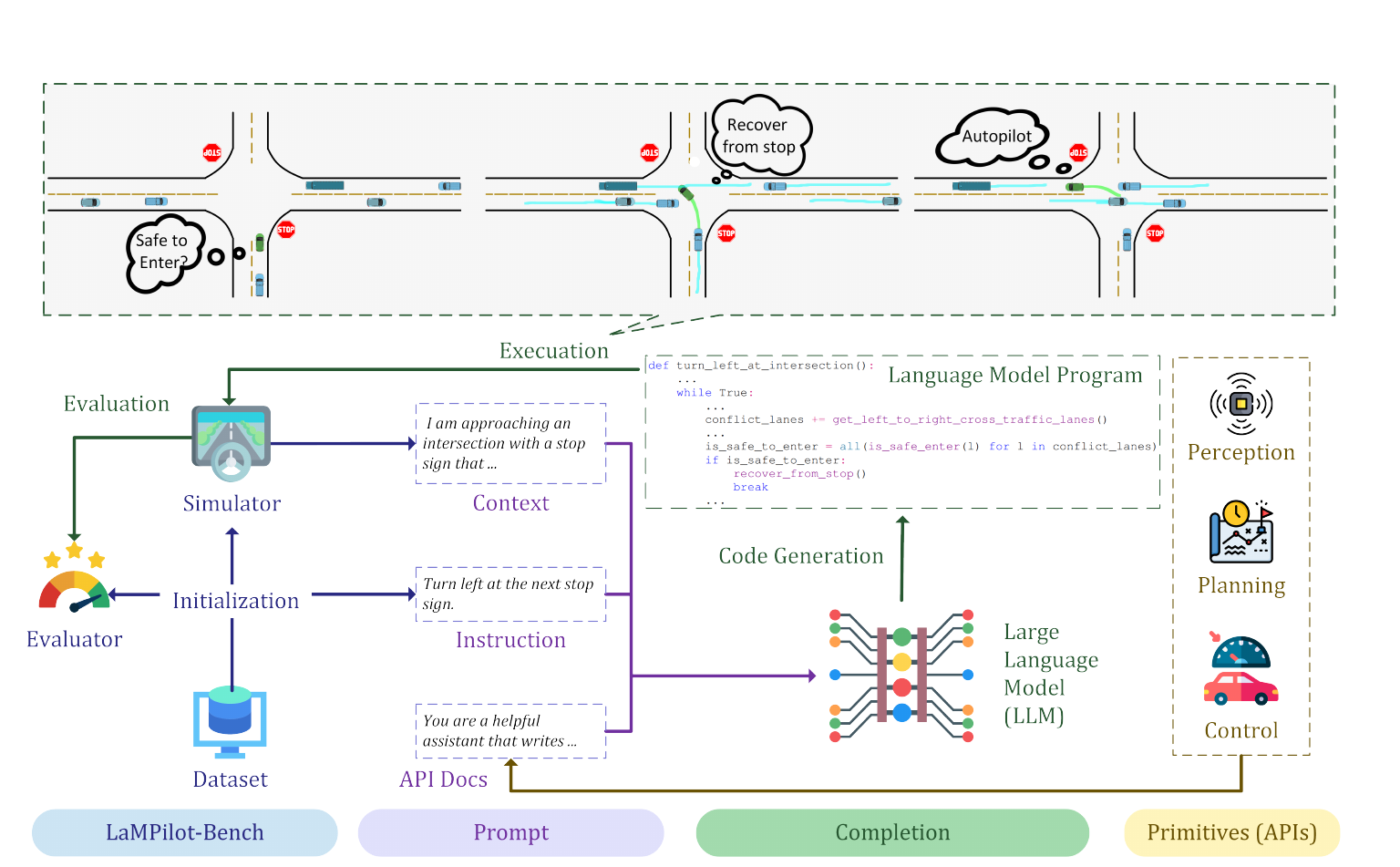
    LaMPilot studies language-model programs over established driving functions. LLM4AD contributes a collaborative review, benchmark, and vehicle-platform experiments that examine language models in autonomous-driving applications.

    LaMPilot, CVPR 2024 · LLM4AD, Proc. IEEE 2026

  3. Scene-grounded dialogue with driver confirmation

    SC-ADAS combines scene interpretation, multi-turn dialogue, and structured function calling. Driver-confirmed requests are converted to ADAS commands; evaluation examines interaction behavior and the latency and context costs of cloud-based generative models.

    Han et al., IEEE ITSC 2025

  4. Generating scenarios and simulating traffic

    SIMSplat studies language-aligned driving-scenario generation with 4D Gaussian splatting, while NIVA studies learned closed-loop multi-agent traffic simulation.

    SIMSplat, ECCV 2026 · Lu et al., IEEE/RSJ IROS 2025

  5. Selecting when reasoning runs

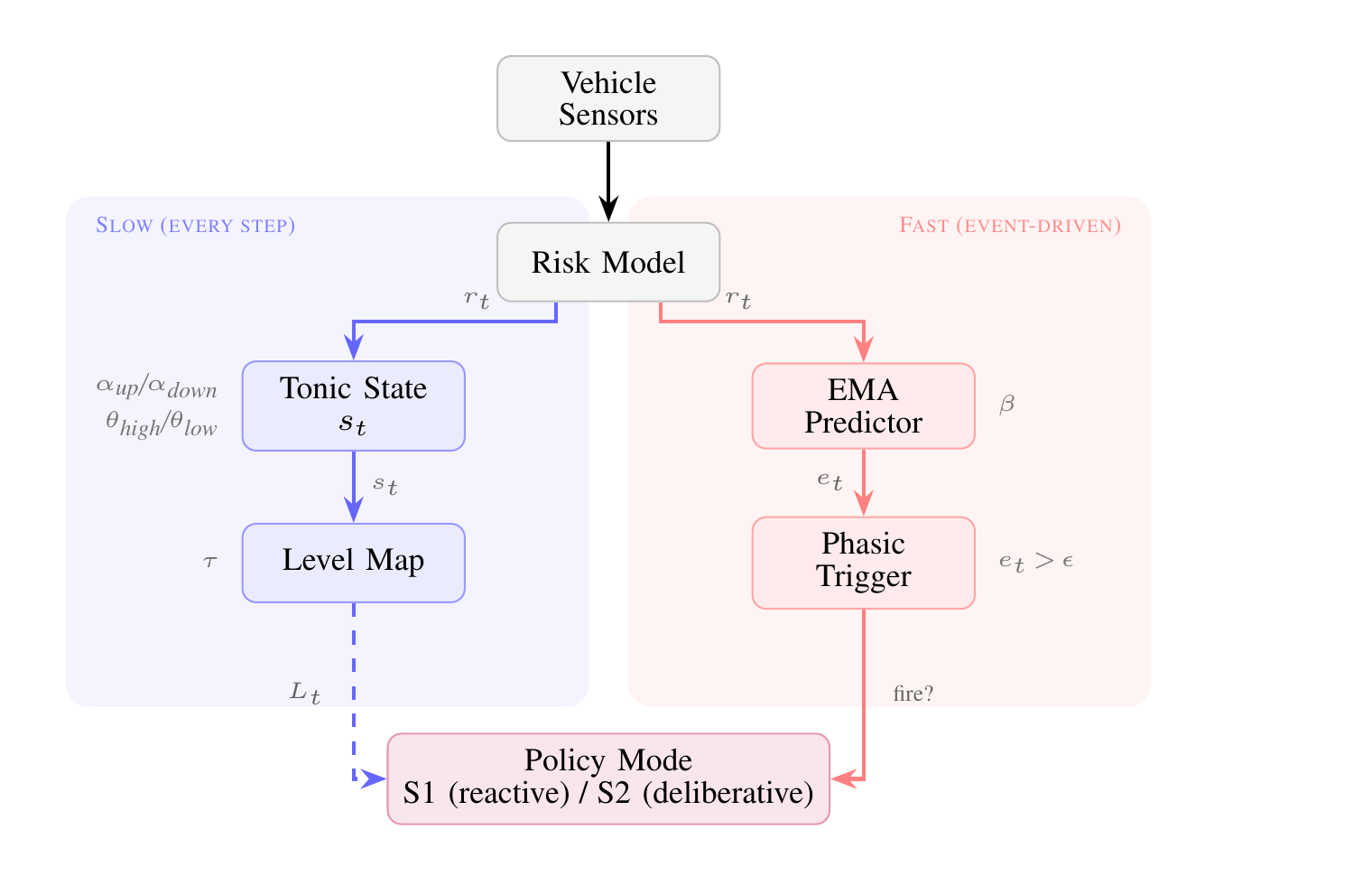
    Tonic meta-control maintains a persistent vigilance state to decide when costly reasoning modules run, evaluated with a synthetic testbench and highway driving simulation.

    Han et al., IEEE ITSC 2026

  6. Related agentic and language-system applications

    Coauthored studies explore agentic trip planning and input-ambiguity detection in language models.

    Chen et al., IEEE IV 2026 · Chen et al., IJCNLP-AACL 2026

Visual overview

LaMPilot's published framework turns language instructions into executable driving programs for evaluation in simulation.

Yunsheng Ma and coauthors (2024), Figure 1, arXiv:2312.04372v2. CC BY-NC-SA 4.0. Rasterized and cropped from the author preprint; labels unchanged. Source for lampilot-framework CC BY-NC-SA 4.0

Tonic's simulation-study architecture separates persistent vigilance from surprise-triggered escalation.

Kyungtae Han and coauthors (2026), existing public Tonic Meta-Control project, architecture figure; unchanged. Source for tonic-architecture

Systems & evidence

  • NuPlanQA uses real-world driving imagery to evaluate multimodal perception and reasoning; SC-ADAS evaluates conversational assistance in CARLA with cloud-based models. (NuPlanQA, ICCV 2025; Han et al., IEEE ITSC 2025)
  • The LLM4AD collaboration reports vehicle-platform experiments comparing cloud and edge deployment. (LLM4AD, Proc. IEEE 2026)

Representative publications

A curated selection. Citations above link to each paper; see the full publication list for all work.

ICCV 2025

NuPlanQA: A Large-Scale Dataset and Benchmark for Multi-View Driving Scene Understanding in Multi-Modal Large Language Models

S. Park, C. Cui, Y. Ma, A. Moradipari, R. Gupta, K. Han, and Z. Wang

Proceedings of the IEEE/CVF International Conference on Computer Vision (ICCV)

CVPR 2024

LaMPilot: An Open Benchmark Dataset for Autonomous Driving with Language Model Programs

Y. Ma, C. Cui, X. Cao, W. Ye, P. Liu, J. Lu, A. Abdelraouf, R. Gupta, K. Han, A. Bera, J. Rehg, and Z. Wang

2024 IEEE/CVF Conference on Computer Vision and Pattern Recognition (CVPR), Los Alamitos, CA, USA

IEEE IV 2025

PDB-Eval: An Evaluation of Large Multimodal Models for Description and Explanation of Personalized Driving Behavior

J. Wu, J. Echterhoff, K. Han, A. Abdelraouf, R. Gupta, and J. McAuley

2025 IEEE Intelligent Vehicles Symposium (IV), Cluj-Napoca, Romania

IEEE ITSC 2025

Scene-Aware Conversational ADAS with Generative AI for Real-Time Driver Assistance

K. Han, Y. Chen, R. Gupta, and O. Altintas

2025 IEEE 28th International Conference on Intelligent Transportation Systems (ITSC)

IEEE/RSJ IROS 2025

On Learning Closed-Loop Probabilistic Multi-Agent Simulator

J. Lu, R. Gupta, A. Moradipari, K. Han, R. Zhang, and Z. Wang

2025 IEEE/RSJ International Conference on Intelligent Robots and Systems (IROS)

IEEE ITSC 2026Accepted

Tonic Meta-Control for Adaptive Safety-Compute Allocation via Persistent Vigilance Dynamics

K. Han, Y. Chen, N. Ammar, and O. Altintas

2026 IEEE 29th International Conference on Intelligent Transportation Systems (ITSC)

Full publication list