IEEE T-ITS
2022
Gaussian Process-Based Personalized Adaptive Cruise Control
Y. Wang, Z. Wang, K. Han, P. Tiwari, and D. Work
IEEE Transactions on Intelligent Transportation Systems, vol. 23, no. 11, pp. 21178–21189
Research question
How can an intelligent system anticipate nearby traffic while accounting for the person using it? Collaborative research spans surrounding-vehicle prediction, personalized car-following and trajectory models, driver monitoring, and trust-aware planning. Studies connect these models to assistance through naturalistic data, public benchmarks, human-in-the-loop simulation, and controlled vehicle experiments.
Early surrounding-traffic studies use probabilistic LSTM models to predict acceleration and propagate vehicle state, and graph-convolution models to incorporate relationships among nearby vehicles.
Gaussian-process models learn individual car-following preferences; the 2022 journal study pairs learned preferences with a predictive safety filter. Inverse reinforcement learning learns preferences from historical driving, while later work adapts gap and acceleration settings from driver overrides.
Wang et al., IEEE ITSC 2021 · Wang et al., IEEE T-ITS 2022 · Zhao et al., IEEE ICRA 2022 · Chen et al., IEEE ITSC 2025
Driver digital twins support online personalized lane-change prediction. Related methods fuse vision and cloud information or use temporal graph networks to represent interactions in trajectory prediction.
Liao et al., IEEE IoT-J 2023 · Liu et al., IEEE T-IV 2022 · Abdelraouf et al., IEEE ITSC 2023
M2DAR recognizes driver actions from multiple views; CEMFormer combines in-cabin and external video to predict intention; driver digital twins support online distraction recognition.
M2DAR, CVPR Workshops 2023 · CEMFormer, IEEE ITSC 2023 · Ma et al., IEEE T-IV 2024
Dilemma-zone studies analyze individual stop-or-go behavior and evaluate a personalized transformer predictor in driving simulation.
Human-subject studies examine changing trust in automated vehicles. Trust-aware route planning models trust as a partially observable human state and evaluates resulting routes in simulator studies.
Sheng et al., IEEE ITSC 2019 · Sheng et al., ACM/IEEE ICCPS 2021 · Sheng et al., ACM TCPS 2022
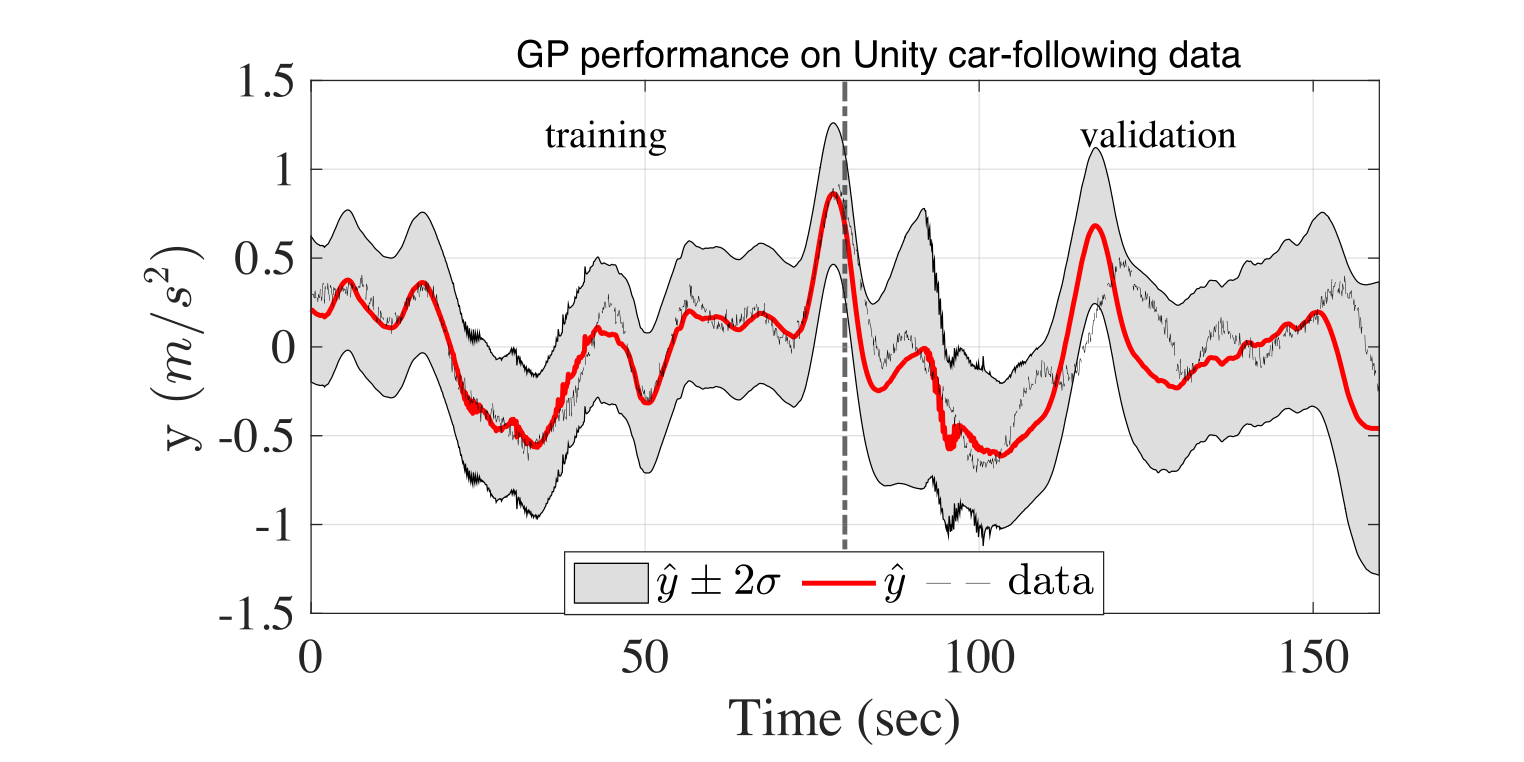
Driver-specific Gaussian-process acceleration predictions versus recorded simulator driving, with separate training and validation intervals.
Y. Wang et al., Gaussian Process-Based Personalized Adaptive Cruise Control, IEEE TITS (2022), Figure 5. DOI: 10.1109/TITS.2022.3174042. © 2022 IEEE. Rasterized and cropped; data and labels unchanged. Reused for the coauthor's personal academic use; no IEEE endorsement. Source for personalized-gp-acc-validation IEEE author-retained rights (not an open license)
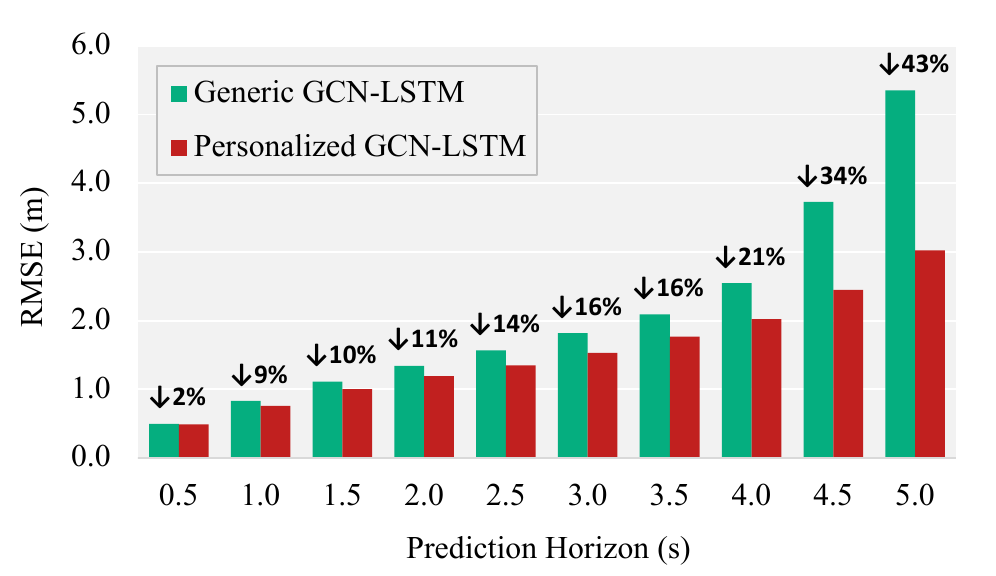
Generic and personalized GCN-LSTM trajectory prediction compared on human-in-the-loop simulation data.
Amr Abdelraouf, Rohit Gupta, and Kyungtae Han (2023), Figure 4, arXiv:2308.07439v2. CC BY 4.0. Rasterized and cropped from the author preprint; data and labels unchanged. Source for personalized-trajectory-results CC BY 4.0
A curated selection. Citations above link to each paper; see the full publication list for all work.
Y. Wang, Z. Wang, K. Han, P. Tiwari, and D. Work
IEEE Transactions on Intelligent Transportation Systems, vol. 23, no. 11, pp. 21178–21189
I. Jones and K. Han
IEEE Intelligent Vehicles Symposium (IV), Paris, France
X. Liao, X. Zhao, Z. Wang, Z. Zhao, K. Han, R. Gupta, M. Barth, and G. Wu
IEEE Internet of Things Journal, vol. 10, no. 15, pp. 13235–13246
Y. Ma, W. Ye, X. Cao, A. Abdelraouf, K. Han, R. Gupta, and Z. Wang
IEEE International Conference on Intelligent Transportation Systems (ITSC), Bilbao, Spain
S. Sheng, E. Pakdamanian, K. Han, Z. Wang, J. Lenneman, D. Parker, and L. Feng
ACM Transactions on Cyber-Physical Systems, vol. 6, no. 4, pp. 31:1-31:21
Y. Chen, K. Han, A. Moradipari, S. Avedisov, S. Mishra, R. Gupta, and O. Altintas
2025 IEEE 28th International Conference on Intelligent Transportation Systems (ITSC)